The science — made actually useful
Not a list of studies. A clear explanation of what's happening in your child's brain and why your current strategies aren't working. AAP/WHO 2026 guidelines translated into daily decisions.
The step-by-step system to end screen meltdowns — for parents of children 0–6.
One-time payment · Lifetime access
Before

After

You've tried the timer. You've tried the five-minute warning. You've tried explaining, negotiating, taking privileges away.
And it always ends the same way: your child on the floor, you exhausted, and the screen back on because you didn't know what else to do.
This isn't a willpower problem. It's a brain problem.
When a screen turns off, a young child's brain goes into genuine distress — the amygdala fires, the prefrontal cortex goes offline. You literally cannot reason with them in that moment.
What you can do is have a system that works with their brain instead of fighting it. That's exactly what's inside this guide.
Preview the ebook
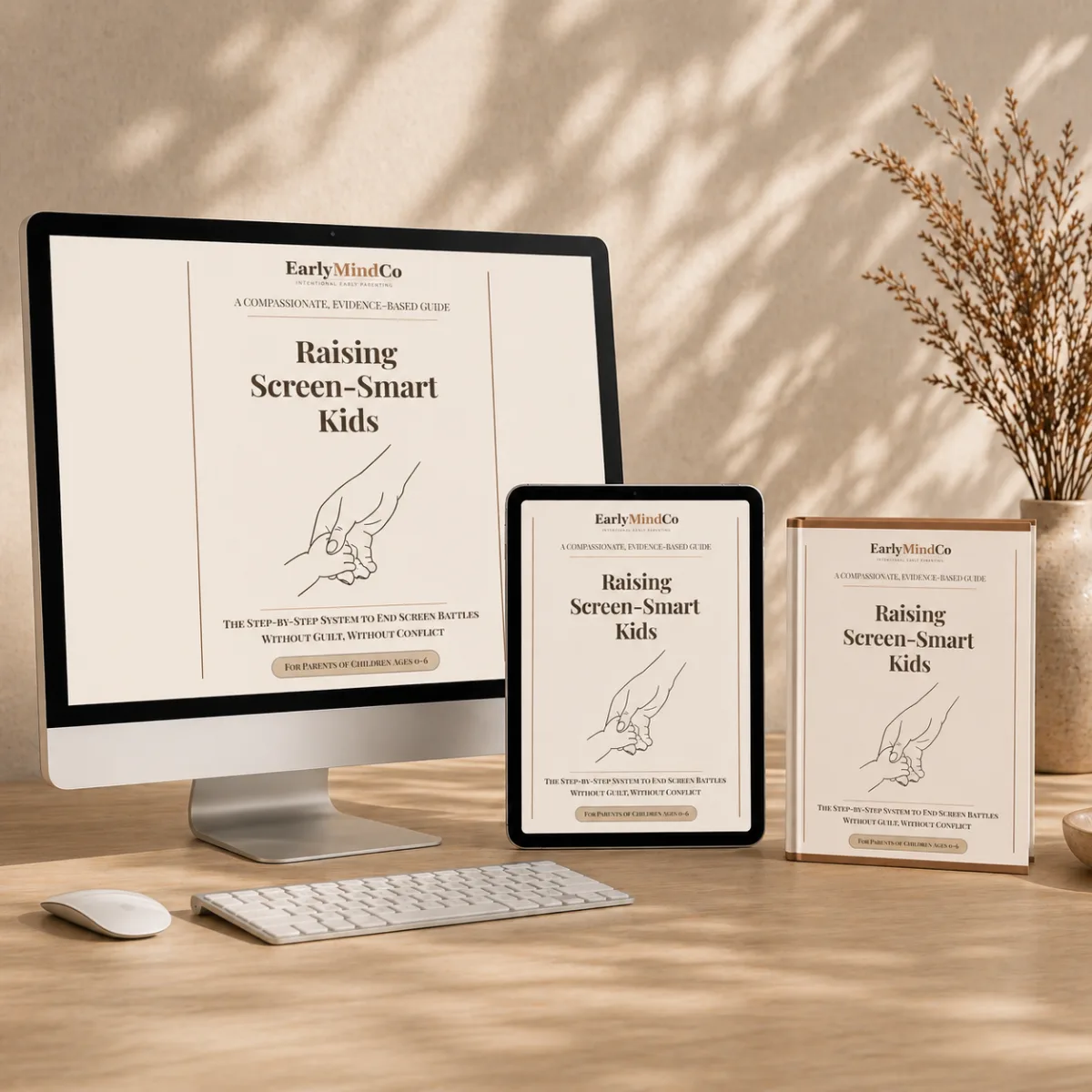
Everything you need to end screen battles — for children ages 0–6.
Digital ebook. Instant download.
60 focused pages. No filler. Tools you can use starting tonight.
Not a list of studies. A clear explanation of what's happening in your child's brain and why your current strategies aren't working. AAP/WHO 2026 guidelines translated into daily decisions.
What works for a 2-year-old won't work for a 5-year-old. You get the right strategies for exactly where your child is right now.
Five steps, under 60 seconds each. Exactly what to say. Exactly what not to say. You can use it the same evening you download it.
Before, during, and after. For every age. For every hard scenario. No more improvising when your child is already spiraling.
How to build shared rules instead of imposed ones. The printable Family Tech Contract. How to get grandparents and caregivers aligned — without conflict.
For when you turn off the screen and need an idea fast. Organized by age group and prep time required.
Weekly Screen Time Tracker · Visual Activity Poster (ages 3–6) · Family Tech Agreement · Age-by-age quick reference chart · 7-Day Quick-Start Plan · Month 1–3 Roadmap
Not "less screen time." Actual end to the daily meltdowns.
★★★★★5.0“I downloaded it on a Tuesday night after the worst meltdown we'd had in months. I read the Meltdown Protocol before bed and used it the very next morning. It actually worked. I couldn't believe something that simple made that much difference.”
Rachel K.
Mom of a 2-year-old
First result in 24 hours
★★★★★5.0“We went from daily tablet wars to calm handoffs in 11 days. The scripts made the biggest difference because I finally knew exactly what to say.”
Laura M.
Mom of a 3-year-old
Zero evening meltdowns this week
★★★★★5.0“I printed the Meltdown Protocol and stuck it on the fridge. My husband thought I was overreacting. Three days later he was following it too. Now it's just how we do things.”
Jess T.
Mom of twins, ages 2 and 4
Whole family on the same page
Yes — especially then. The guide includes a gradual reduction protocol built specifically for children who react intensely when screens are turned off.
There's a full section on exactly this, with scripts designed to align other caregivers without creating conflict.
Probably — but the value isn't in new information. It's in the tools: ready-to-use scripts, step-by-step protocols, printable checklists. The difference between knowing and actually being able to do it at 6pm on a hard Tuesday.
You can use the Meltdown Protocol tonight. Most parents notice a measurable difference within 7 days. A stable new pattern takes 3–4 weeks.
No. One payment. Lifetime access. No auto-renewals.
It's a digital PDF. After purchase you receive an instant download link by email. You can read it on your phone, tablet, or computer — and print any page you want, including the appendices.
Instant access. Start reading in 2 minutes.
Pick one tool. The Meltdown Protocol is a good start.
Most parents report a measurable difference within 7 days.
Every week of chaotic screen habits is a week the pattern gets more established — in your child's brain, and in your family's routine.
You don't need perfection. You need a system. This is the system.

